Germany's AI Push: NVIDIA's Role in Industrial Transformation
NVIDIA Writers
The Skyward angle
Germany is positioning itself as a global leader in industrial AI, focusing on integrating advanced technology into its robust manufacturing and automotive sectors. The partnership between the German government and NVIDIA aims to enhance AI adoption among small and medium-sized enterprises, which could significantly impact educational initiatives in STEM fields, preparing learners for future careers in a tech-driven economy. This collaboration underscores the importance of fostering an innovative environment for both teachers and students, enabling them to engage with cutting-edge developments in AI and industry.
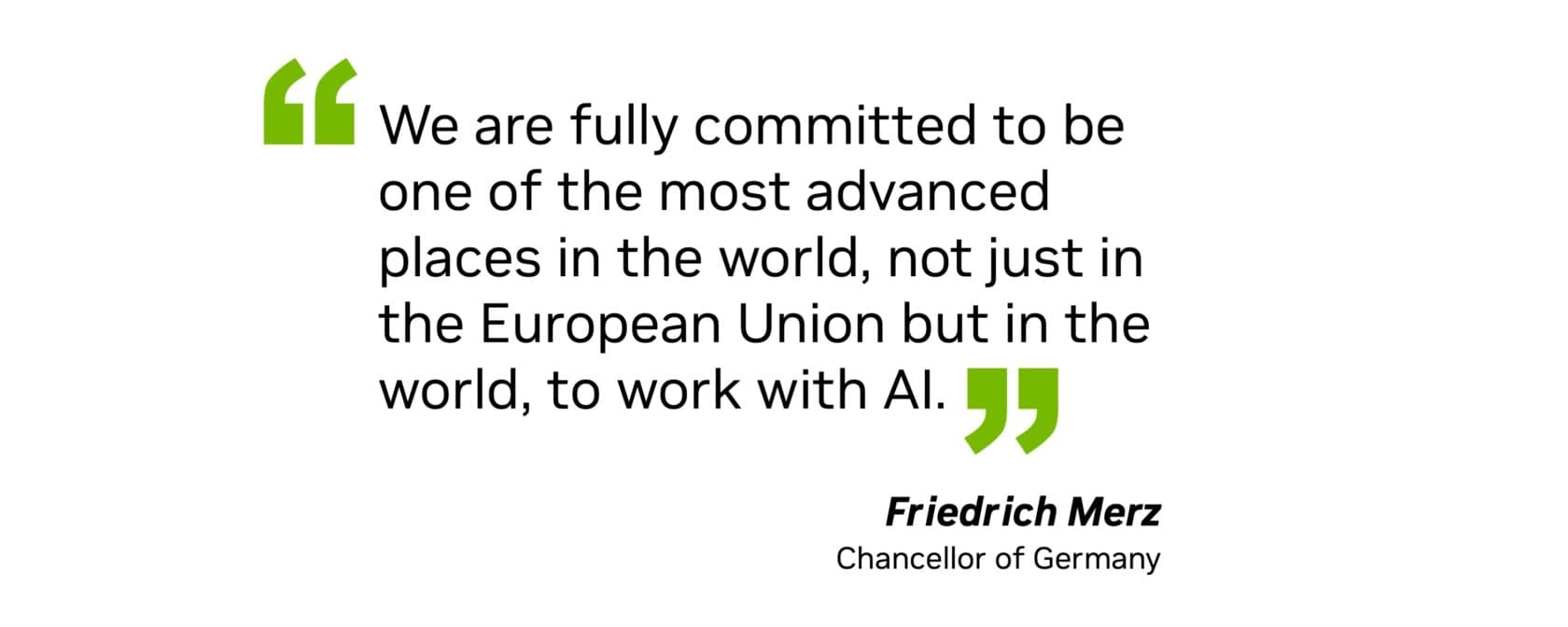
Based on NVIDIA AI BlogIn a significant move towards integrating artificial intelligence (AI) into its industrial sector, Germany is partnering with NVIDIA to enhance its manufacturing and automotive industries. German Chancellor Friedrich Merz and NVIDIA's founder and CEO Jensen Huang recently discussed this collaboration at a former power station in Berlin. Their conversation centered around Germany's strengths in manufacturing and automotive sectors and how AI can bolster these industries.
As part of the Invest in Germany Summit, a Joint Declaration of Intent was signed involving NVIDIA and several German ministries. This agreement aims to blend Germany's traditional engineering and manufacturing expertise with advanced AI technologies. The initiative seeks to introduce industrial AI widely and establish a cutting-edge AI ecosystem in Europe.
Why this matters
Germany's ambition to lead in industrial AI signifies a commitment to maintaining its competitive edge in global manufacturing. By leveraging AI, Germany plans to enhance its production capabilities, making processes more efficient and innovative. The focus on small and medium-sized enterprises (SMEs), known as the Mittelstand, highlights the importance of integrating AI into businesses that form the backbone of the German economy. This approach not only aims to improve productivity but also to solidify Germany's position as a leader in industrial innovation.
What it means for learners and teachers in Africa
The collaboration between Germany and NVIDIA offers several lessons for African educators and students. The emphasis on combining traditional expertise with modern AI technology can serve as a model for African educational institutions aiming to update their curricula to include AI and other emerging technologies. With access to AI, learners can gain skills that are increasingly relevant in the global job market. For teachers, understanding AI's applications in industries can provide a framework for developing courses that align with current technological trends.
However, challenges such as cost, access to technology, and infrastructure remain significant in many African countries. Initiatives that focus on affordable AI education and partnerships with technology companies could help bridge these gaps. Moreover, incorporating AI into sectors like agriculture, mining, and healthcare could provide local examples that resonate with African students.
What to watch next
As Germany and NVIDIA progress with their AI initiatives, it will be crucial to observe how these developments influence global AI adoption, especially in manufacturing and automotive industries. The success of incorporating AI into SMEs in Germany could inspire similar strategies in other countries, including those in Africa. Additionally, the investments in German startups by NVIDIA highlight the potential for tech-driven innovation, which may encourage similar investments in African tech ecosystems.
Monitoring how Germany's AI roadmap unfolds can provide valuable insights for countries looking to integrate AI into their industries. The outcomes of this collaboration could serve as a benchmark for the effectiveness of AI in transforming traditional sectors and offer a glimpse into the future of industrial innovation.
Based on reporting by NVIDIA AI Blog. Written by Skyward.